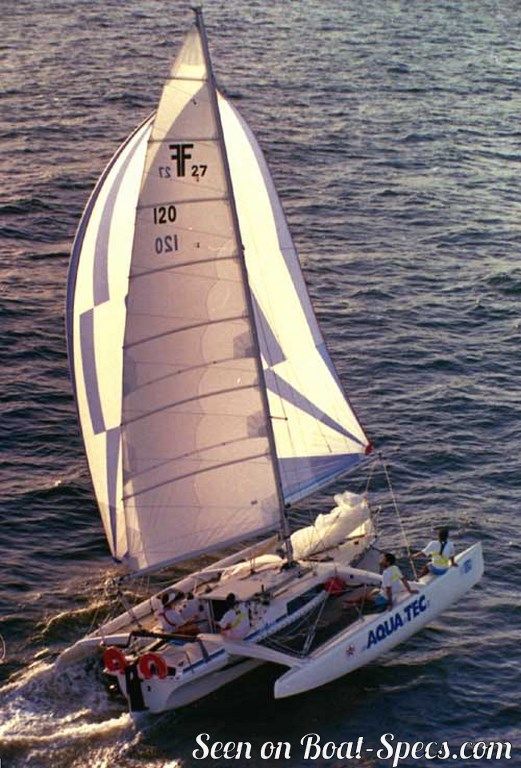
Corsair F-27 Sailing Manual
N/A €Corsair F24 MkII's Main dimensionsFolding typeFarrier's type, double-hinge with horizontal axisHull length24’ 2”Waterline length23’ 7”Beam (width)17’ 11”Draft1’Draft when appendages up4’ 7”Mast height from DWL36’ 8”Light displacement1799 lbsFrench customs tonnage3.63 TxCorsair F24 MkII's Rig and sailsUpwind sail area364 sq.ftMainsail area242 sq.ftJib area122 sq.ftRigging typeSloop Marconi fractionalRotating sparsYesMast positionDeck stepped mastSparsMast and boom in AluminumStanding rigging1x19 strand wire continuousNumber of levels of spreaders1Spreaders angleSwept-back (diamond). Corsair F24 MkII's PerformancesUpwind sail area to displacement i The ratio sail area to displacement is obtained by dividing the sail area by the boat's displaced volume to the power two-thirds.The ratio sail area to displacement can be used to compare the relative sail plan of different sailboats no matter what their size. Upwind: under 18 the ratio indicates a cruise oriented sailboat with limited performances especially in light wind, while over 23 it indicates a fast sailboat.38.71Displacement-Length ratio (DLR) i The Displacement Length ratio is a figure that points out the boat's weight compared to its waterline length. DLR is obtained by dividing the boat's displacement in tons by the cube of one one-hundredth of the waterline length (in feet).The DLR can be used to compare the relative mass of different sailboats no matter what their length: a DLR less than 180 is indicative of a really light sailboat (race boat made for planning), while a DLR greater than 300 is indicative of a heavy cruising sailboat.62Corsair F24 MkII's Auxiliary engineEngine(s)1Engine typeOutboard engineEngine (min/max)5 HPFuel typeGasCorsair F24 MkII's AccommodationCabin(s)1Berth(s)4.
The Balatik, a 74 ft (23 m) functional replica of large traditional sailing of the in the, an example of an double-The first double- were developed by the and are still widely used today by traditional fishermen in. It developed from the more ancient single-outrigger boats as a way to deal with the problem of the instability of the latter when. Double-outrigger boats, however, did not develop among Austronesians in and (although it exists in western ), where single-outrigger boats and are used instead. LoeRea, 60-foot (18-metre) trimaran used in the movie,.According to usage, there are three that describe the main components of and trimarans, namely: “vaka”, “aka” and “ama”.
is the or main hull. is the framework member that connects the vaka (hull) to the ama (outrigger, or “float”). is the outrigger, connected to the vaka by an.(The above terminologies reflects only usage. In the UK the main hull of a trimaran is called simply the main hull or centre hull. The hulls are or 'outriggers'.
The structures between the main hull and the floats are called the wings and the structural portions thereof are beams).In most cruising trimarans the wings are solid and cabin accommodation extends over them, while in racing trimarans accommodation is limited to the main hull and the wings are open sheets of netting.Comparison of modern trimarans to traditional outrigger canoes In comparison to traditional Austronesian, modern western-built trimarans typically do not use Austronesian like. Dp965lt windows 7 drivers. Instead they use a standard. Trimarans are also typically significantly wider. In addition, trimaran floats are much more buoyant than those of outrigger canoes to support a large sailplan. They contribute to drag when heavily immersed, and their level of immersion indicates when to.
In terms of performance, an objective comparison by Doran (1972) in terms of maximum progress against the wind, maximum speed, and speed downwind concluded that both the traditional double-outrigger of the and the single-outrigger of the, respectively, are still superior to the modern trimaran. Comparison to monohulls. This section needs additional citations for. Unsourced material may be challenged and removed.Find sources: – ( February 2015) Two types of trimaran exist: the bridgedeck trimaran and the open trimaran, which features a trampoline between the hulls instead of any platform.Trimarans have a number of advantages over comparable, principally being very much faster and less prone to heeling (although a trimaran heels more than a ). Comparing a trimaran and a monohull of the same length, the former has a shallower, a wider, less wetted area, and is able to fly more sail area.
Because of the righting moment provided by the wide beam, trimarans do not need a monohull's. As a result of the wide beam, the trimaran is able to maintain its stability in stronger winds, thereby offering much better straight-line performance than a, along with the ability to navigate in shallower water. However, its wider beam requires more space to manoeuver, so and can be trickier in confined areas. Trimarans with open wings typically have narrower hulls (and thus less living space) than a same length monohull; but trimarans with solid wings can have a bridgedeck giving ample saloon accommodation. Trimarans require significantly more docking space in marinas, unless the ama can be folded to reduce the beam.As the righting (the force that resists the opposite torque of the wind on the sails) is produced by a, or, rather than a heavy protruding, trimarans are lighter and faster than a of equivalent length. A lightweight retractable or foil, referred to as a or, is often employed to resist movement, making many models easily beachable.
Most trimarans are difficult to flip sideways given a reasonable degree of caution, however, trimarans can reach speeds so great in high winds that they can plow into the back of a wave and flip end-over-end (pitchpole). This hazard is especially dangerous for a that is using a spinnaker in high winds and large seas. To avoid this unfortunate scenario trimaran sailors are advised to reduce sail and to always have all sails easily released.
The use of trampolines with a large weave, to allow water to easily pass through, and the deployment of parachute anchors and whenever appropriate should reduce the risk to an acceptable degree.Folding trimarans. Weta Trimaran racing in the High Sierra RegattaSeveral manufacturers build trimarans in which the can be removed, repositioned, or folded near to the main hull. This allows them to be and/or to fit in a normal space in a.At least six technologies are in use:. Demountable fixed tubes: Some trimarans are built demountable to allow them to be trailered to a launch site and then assembled before launching. This takes longer than a folding system but is typically lighter and less costly, and can also be used for craft with too much beam for a folding system.
For example, the small modern uses tubes to connect the floats to the main hull, which are lashed in from a canvas trampoline and further held in place by the sidestays. Similarly, the original (Dragonfly 600) and the home built use this design. Telescopic tubes: The French company produces a range of trimarans that use tubes to connect the floats to the main hull. Hinge and latch: The uses a strong hinge and latch system that allows the amas to fold over the main hull to reduce width for trailing. Suitable for craft under 18 ft only unless waterstays are added. Vertical folding: use a vertical folding mechanism, first used on the Trailertri and subsequently on most of his designs. All Farrier designed boats are known as Fboats (F22, F24, F27 etc.).
Also uses a vertical folding mechanism as do, who use the vertical folding mechanism designed by Ian Farrier. (When Farrier resigned from the company in 2000, the 'F' (for Farrier) designation was replaced with a 'C' (for Corsair) designation on their trimarans.) trimarans use a folding mechanism claimed to be a further development of the Farrier design. Horizontal articulation: use a nearly horizontal articulation called SwingWing. The slight angle makes the floats fold into the narrower, lower part of the central hull and also increases stability when in the folded position.
A similar horizontal articulation design is also used in the Sea on 96CRB. This kind of system was first used in trimarans designed by John Westell and built by Honnor Marine Ltd of. Horizontal folding: uses a unique horizontal folding design along with a simple mast raising system to facilitate trailer sailing.
It can be powered easily with the amas folded in or extended.Safety Although it is possible for a trimaran to capsize, this is less frequent than with boats because of the greater resistance to rolling that the offer. Most trimaran designs are considered nearly unsinkable because even when filled with water, the buoyancy of one ama is enough to keep the entire vessel afloat.
Because of their stability and safety, special trimarans such as the Challenger have become popular with sailors who have restricted mobility.Trimarans designed for safety have with multiple sealed partitions, controls that all run to the, a collision, partial or full cockpit coverings or windshields, and drain holes in the cockpit that can adequately drain the cockpit quickly, among other things.Trimaran capsizes are more likely to be of the pitchpole type than a roll to one side due to their higher sideways stability and speeds. Trimarans are harder to turn upright after they have than monohull boats. While some capsized trimarans righted by sideways rotation may suffer heavy damage to mast and rigging, many modern and ancient trimarans are explicitly designed for this method of righting.
Corsair F 28 For Sale

Harnesses pulling on the stern toward the bow, or from the bow toward the stern of capsized trimarans have been shown to be able to successfully turn them end-over-end. Several design features reduce the chance of pitch-pole capsize; these include having wing nets with an open weave designed to reduce windage and decks and nets that shed water easily. The best way to avoid capsize is to reduce sail in heavy weather. 33rd America's Cup Competing with a giant trimaran the team representing the won the on February 14, 2010, off, beating the giant 2-0 in the best-of-three series and becoming the first American syndicate to win the cup since 1992. The large rigid wing sail of the USA 17 trimaran provided a decisive advantage and the trimaran won the by a considerable margin in each race.World records holds the new world record for solo circumnavigation of the world by sailing the trimaran, Sodebo Ultim, set on December 25, 2016 with a time of 49 days and 3 hours. Prior to his feat, held the world record for solo circumnavigation of the world, set on January 20, 2008.
The 51-year-old Frenchman circled the planet alone in 57 days, 13 hours, 34 minutes, 6 seconds in a trimaran. He beat British sailor 's record set in February 2005 for which she spent just over 71 days at sea.Francis Joyon and crew of five sailors; Dec 2016–Jan 2017; the Maxi trimaran IDEC SPORT; current absolute (wind or mechanically powered) fastest maritime circumnavigation, in 40 days 23 hours 30 minutes 30 seconds of sailing.
Average speed of 26.85 knots (30.71 MPH), covering a total distance of 26,412 nautical miles (48,915 km; 30,394 mi). holds the current UIM (Union Internationale Motonautique) powerboat record for an equatorial circumnavigation via the Panama and Suez canals., an experimental trimaran, briefly reached 56.3 knots (104.3 km/h; 64.8 mph) near, but and shortly thereafter. In naval ships was a Research Vessel for the. She was built as a technology demonstrator ship for the Royal Navy's Future Surface Combatant, and has been used to prove the viability of the hull-form. Since 2007 the ship has been used by the 's.built by at are of a trimaran design.
Is the first of these ships. Built by are of a monohull design.First launched on 31 August 2012 at Bali Strait, 63M Carbon Fibre Composite Trimaran Fast Missile Boat (: Kapal Cepat Rudal KCR) named KRI Klewang (625) – a traditional Indonesian single edge sword, was the first stealth trimaran of the built by at,. This ship combined a number of existing advance technologies into a single, unique platform; a wave-piercer trimaran hull from, constructed exclusively of infused vinylester carbon fibre cored sandwich materials for all structural elements, with external 'stealth' geometry and features intended to reduce detection. The KRI Klewang (625) caught fire because of an electrical short-circuit in the engine room during a maintenance period on September 28, 2012 and was a total loss.43 Meter Trimarans called Ocean Eagle from CMN wharf with design from und Prolarge based on the concept will provide coastal protection for Mozambique.Image gallery sailing trimarans. Collins English Dictionary – 2007 – Harper Collins –.
^. Multihull Maven. Mahdi, Waruno (1999). 'The Dispersal of Austronesian boat forms in the Indian Ocean'.
In Blench, Roger; Spriggs, Matthew (eds.). One World Archaeology. P. 144-179. Doran, Edwin B. Wangka: Austronesian Canoe Origins. Texas A&M University Press. Beheim, B.
(23 February 2011). Proceedings of the Royal Society B: Biological Sciences. 278 (1721): 3089–3095. ^ Hornell, James (1932).
'Was the Double-Outrigger Known in Polynesia and Micronesia? A Critical Study'. The Journal of the Polynesian Society.

41 (2 (162)): 131–143. Doran, Edwin, Jr. The Journal of the Polynesian Society.
83 (2): 130–140. (1965). 'Catamarans: A Revolution in Sailing History'. Sorority, Inc. (Fall 1965): 12.
Now gaining popularity is the trimaran, a triple-hulled craft of an ancient origin as the catamaran. Trimarans have now crossed both the Atlantic and the Pacific. Randy Thomas. Retrieved 2015-01-01.
Archived from on 2006-04-22. Archived from on 2008-08-20. Archived from on 2012-08-09. Retrieved 2012-08-16. Archived from on 2007-10-20.
Retrieved 2007-10-30. ^. Archived from on 2007-10-08. Retrieved 2007-10-30. Edwin Doran Jr., Texas A. University (1972)., Volume 81, No.
Retrieved 2015-01-01. In contrast to double-outrigger canoes, however, trimaran floats are often quite large and buoyant and contribute considerably to drag which slows the boat. The Pacific canoes are notably more narrow (length/beam ratios of about 10 and 13 respectively) than the trimaran (ratio of about 7). That is, conventional, single-hulled. Such as the Dragonfly 28.
Retrieved 2009-08-08. Retrieved 2009-01-09.
Retrieved 2009-10-10. Archived from on 2011-04-09. Retrieved 2009-05-10. David Owen (1970). Archived from on 2011-04-02. Retrieved 2009-05-26. Retrieved 2015-01-01.
Edwin Doran Jr., Texas A. University (1972)., Volume 81, No. Retrieved 2015-01-01. Seaworthiness is implicit in the ability to make such voyages. A specific point illustrating the latter is the technique known to for righting their canoes after they have capsized at sea.
In brief, the mast is rigged from under side of float to a sheer legs erected above the bottom of the capsized boat. Four men climb quickly up the inclined mast, their weight forcing the float to submerge to a point directly underneath the main hull. Past this point the float's own buoyancy takes it back to the surface in righted position whereupon the canoe is bailed, rerigged and continues on its voyage. Staff (December 25, 2016). Deutsche Welle.
Retrieved 2019-02-19. Though it was first announced the ship reached 61 kn: (in French). 2010-10-08 at the, 14 January 2009 (in French).: Catamaran Racing.
December 22, 2008. Retrieved 2013-11-19.References.
Jim Howard, Charles J. Tiller Pub.External links.
Comments are closed.